
Contents
- Melonie enjoys writing about science, economics, and technology. She currently writes for AlliedSatelliteTV.com
- 1 Drive Smoothly
- 2 The Speed Limit is Your Friend
- 3 Keep it Light
- 4 Don’t Idle
- 5 Use that Cruise Control
- Melonie enjoys writing about science, economics, and technology. She currently writes for AlliedSatelliteTV.com
Melonie enjoys writing about science, economics, and technology. She currently writes for AlliedSatelliteTV.com
Gas prices are crazy right now, and it doesn’t look as though they’re going to improve any time soon. Between ongoing conflicts in the Middle East and the erratic rise and fall of the world’s financial markets on a near daily basis in response to wars and natural catastrophes – there’s very little chance of fuel prices stabilizing, much less falling to reasonable levels again.
Since not everyone can afford a fancy electric hybrid vehicle, and at least a few used cars survived the Cash for Clunkers program of two years ago – that leaves most of us faced with the decision of whether to drive or not. For those of us who have jobs to get to, it’s not a question at all.
But there are things you can do to maximize the fuel in your tank without having to buy a new car or grow wings. Here are some tips from the U.S. Department of Energy that will make getting out and about at least a tad less costly:
1 Drive Smoothly
Choppy driving with repetitive stepping on and off the gas, speeding up then slowing down frequently, and weaving in and out of traffic can decrease your fuel efficiency by up to 33 percent on the highway, and 5 percent during in town driving. The more consistent your driving pattern stays, the further your gas will go.
2 The Speed Limit is Your Friend
 Gas mileage loses efficiency in most vehicles at about 60 mph. For each mph over 60 mph you go, it’s like paying an extra twenty-four cents per gallon of gas. That’s a figure that shocks a lot of people, but it’s the truth. The closer you stay to 55 mph, the closer your cost per gallon stays to what you paid for it.
3 Keep it Light
If you routinely store unnecessary items in your trunk or backseats, you are burning fuel inefficiently. There is a way this can be figured using the percentage of extra weight in the car and its relativity to the vehicle’s own weight. This affects smaller cars more than large ones. For each 100lbs of extra ballast on board, your MPG can be reduced by as much as 2 percent.
4 Don’t Idle
The only time you get 0 mpg is when your car is running, sitting still (otherwise known as “idling.”) Idling is a complete waste of gas for all vehicles, but the larger a car’s engine is, the more gas is wasted when the car is not in motion. Some people switch off their cars when parked in long lines, such as at banks or fast food drive through windows – but this can also waste gas, depending on how long the wait is and how many times you have to crank the car.
5 Use that Cruise Control
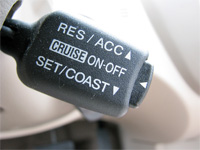
 When driving on the highway, using cruise control usually helps equipped vehicles to get better gas mileage by keeping the car at a constant speed (see tip #1 above.) For people who don’t spend as much time on the open highway, cruise control may not be very helpful, but it nearly always results in improved gas mileage for people who do.
These are just a few tips that will hopefully help your gas last a little longer. At least until we discover the next amazing sustainable energy source.
Melonie enjoys writing about science, economics, and technology. She currently writes for AlliedSatelliteTV.com