
- 🥇 Best Overall: The Revenant — a brutal, immersive survival epic with craft to match its punishment
- 💰 Best Value: 127 Hours — lean, unforgettable, and powered by one extraordinary central performance
- 🌊 Best Ocean Survival: All Is Lost — nearly wordless disaster filmmaking with one man, one boat, and no mercy
- 🏔️ Best Mountain Nightmare: Everest — large-scale altitude terror built around real expedition details
- 🧊 Best Cold-Weather Thriller: Arctic — stripped-down polar survival with no melodrama and maximum bite
- 🐺 Best Predator Showdown: The Grey — a bleak, muscular wolf-country thriller about death as much as survival
- 🌴 Best Spiritual Adventure: Life of Pi — a visually dazzling shipwreck story with a tiger, faith, and fear
- 🏄 Best Beach-Sized Terror: The Shallows — tight, stylish, and shark-smart without wasting your time
- 🌧️ Best Disaster Realism: The Impossible — devastating tsunami cinema focused on one family’s ordeal
- ❄️ Best True-Story Endurance: Society of the Snow — the most harrowing recent survival film about communal will
Nature does not need a villain monologue. Give it thin air, freezing water, a starving animal, a storm front, or one bad decision, and suddenly you are watching people negotiate with forces that do not negotiate back.
The best man vs. nature movies of the past 20 years work because they make you feel the math: minutes of oxygen, calories left, daylight fading, waves rising, body temperature dropping. These 10 films are the modern essentials when you want survival cinema that feels physical, specific, and hard-earned.
1The Revenant
Best for: viewers who want a punishing survival epic with prestige-level filmmaking and raw frontier violence.
The Revenant is the modern benchmark for man vs. nature cinema because it does not treat wilderness as scenery. Alejandro G. Iñárritu drops you into 1820s fur-trapper country and makes every river crossing, frozen breath, and tree line feel hostile. Leonardo DiCaprio plays Hugh Glass, a frontiersman mauled by a grizzly, abandoned by his party, and forced to crawl, stagger, and improvise his way through the American wilderness in pursuit of survival and revenge.
The differentiator is total immersion. Cinematographer Emmanuel Lubezki shot the film largely with natural light, giving the snow, mud, and firelight a tactile harshness that polished studio survival films rarely capture. The production shot in locations including Canada and Argentina, and the result is a $135 million-scale film that still feels dirty, intimate, and bodily. DiCaprio’s Oscar-winning performance is built from grunts, shivers, wounds, hunger, and stubborn forward motion rather than speeches.
Watch it when you want nature presented as a complete sensory assault. It is not the most scientifically precise survival film on this list, and the revenge plot gives it a mythic shape, but that is also why it hits so hard. Compared with something minimalist like All Is Lost, this is maximalist survival: blood, snow, arrows, avalanches, icy rapids, and the crushing sense that the landscape is larger than every human plan.
2127 Hours
Best for: anyone who wants a compact, true-story survival film that turns one trapped body into a full psychological arena.
Danny Boyle’s 127 Hours proves you do not need a continent-sized wilderness to make nature terrifying. You need one canyon, one falling boulder, and one person who told nobody exactly where he was going. James Franco plays Aron Ralston, the real outdoorsman whose arm was pinned by an 800-pound boulder in Utah’s Bluejohn Canyon in 2003, leaving him trapped for more than five days with dwindling water and almost no options.
The film’s power is in its precision. You track hydration, temperature, video-battery life, hallucinations, and the terrifying countdown of a body running out of time. Boyle uses split screens, memory bursts, and music to keep the movie kinetic, but he never lets you forget the physical facts of the trap. Ralston’s own account, documented in his memoir Between a Rock and a Hard Place, gives the film a procedural edge: this is about judgment, preparation, panic control, and the brutal cost of rescue when rescue is not coming.
The caveat is obvious: the climactic self-amputation scene is not casual viewing. Still, it is not exploitation; it is the price of the premise. If you hike, climb, canyon, or even just disappear on solo weekend trips, this is the movie that quietly asks whether someone knows your route. For more on the real geography that makes canyon travel so risky, the National Park Service canyoneering guidance is a useful real-world companion.
3All Is Lost
Best for: viewers who love minimalist survival stories where every rope, tool, and decision matters.
All Is Lost is one of the purest modern man vs. nature films: Robert Redford, a damaged sailboat, the Indian Ocean, and almost no dialogue. J.C. Chandor strips away backstory, family drama, and comic relief so you can focus on process. A shipping container punctures the hull of a solo sailor’s yacht, and from that first impact the film becomes a methodical inventory of what breaks, what can be patched, and what the sea takes next.
What stands out is how seriously the movie treats competence. You watch Redford’s character repair fiberglass, pump water, navigate with a sextant, ration supplies, deploy a life raft, and respond to storms with the tired discipline of someone who has done hard things before. The production reportedly used multiple boats and water tanks, but it feels uncannily simple: one aging body against weather, saltwater, and bad luck. Redford was in his mid-70s during filming, which gives every climb and fall extra weight.
This is not a rah-rah survival thriller. It is quiet, lonely, and occasionally maddening because the ocean is indifferent rather than theatrical. If you need banter, flashbacks, or a villain, choose The Grey instead. If you want a film that makes you think about EPIRBs, life rafts, bilge pumps, and how fast confidence becomes exposure, All Is Lost is essential.
4Everest
Best for: disaster-movie fans who want real expedition logistics, lethal altitude, and a big ensemble cast.
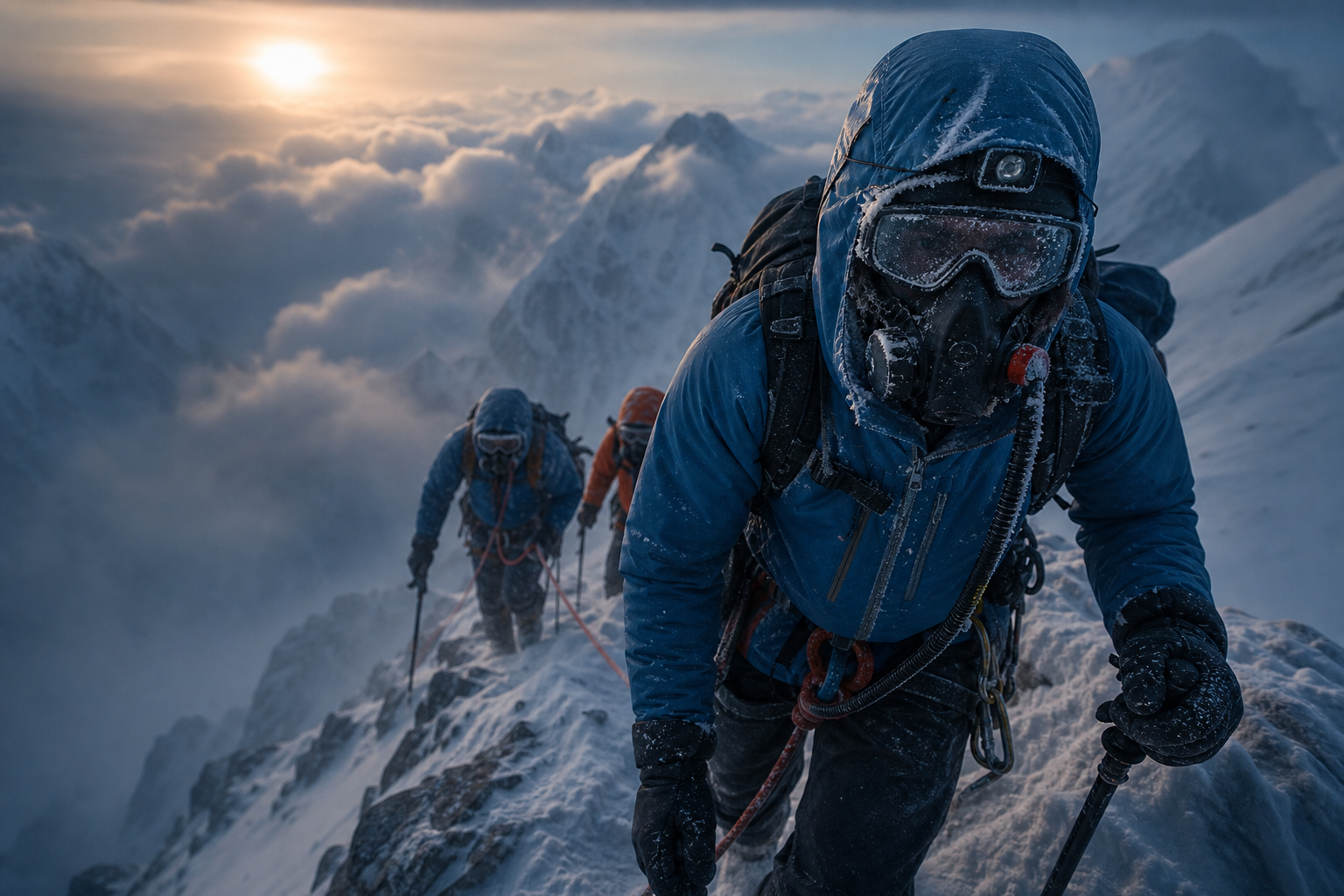
Everest turns the 1996 Mount Everest disaster into a sobering lesson in bottlenecks, weather windows, oxygen systems, and human ambition. Directed by Baltasar Kormákur, the film follows commercial climbing teams led by Rob Hall and Scott Fischer as they attempt to summit the world’s highest mountain, only to be caught in a catastrophic storm. The cast is stacked—Jason Clarke, Josh Brolin, Jake Gyllenhaal, Keira Knightley, Emily Watson—but the mountain remains the dominant presence.
The real differentiator is the film’s attention to expedition mechanics. You see fixed ropes, radio calls, turnaround times, supplemental oxygen, acclimatization pressure, and the infamous traffic near the Hillary Step. Everest’s summit is 29,032 feet above sea level according to modern measurements, and the movie understands that above 26,000 feet—the so-called death zone—your body is not recovering; it is deteriorating. That physiological reality makes every delay terrifying.
Do not watch Everest for a simple hero narrative. Its strength is that it shows how overlapping small failures become fatal: late starts, crowded routes, exhausted clients, storm timing, and the commercial pressure to reach the top. If you want context beyond the film, the Encyclopaedia Britannica overview of Mount Everest gives clear background on the mountain’s geography and climbing history.
5Arctic
Best for: viewers who prefer stripped-down survival realism over speeches, flashbacks, and Hollywood rescue clichés.
Arctic is what happens when a survival movie trusts silence. Mads Mikkelsen plays Overgård, a man stranded after a plane crash somewhere in the polar wilderness. He has routines: ice fishing, hand-cranked distress signals, map checks, rationing, and maintaining a giant SOS carved into the snow. Then a failed rescue attempt leaves him responsible for another injured survivor, forcing him to abandon relative stability and cross the ice.
The movie’s genius is its refusal to over-explain. You do not get a sentimental montage of who Overgård left behind. You get a man calculating risk in a place where a wrong turn can be fatal. Director Joe Penna makes basic actions—pulling a sled, checking a wound, climbing an icy slope—feel monumental. Mikkelsen’s performance is all controlled fatigue and micro-decisions, the kind of acting that tells you exactly how much energy a person has left.
Arctic is less spectacular than The Revenant and less plot-heavy than Everest, but that restraint is its advantage. It is an excellent pick when you want survival stripped to temperature, distance, injury, and willpower. The caveat: if you need constant escalation, the pacing may feel severe. Stay with it, though, and you get one of the cleanest modern portraits of endurance under cold stress.
6The Grey
Best for: viewers who want a bleak wilderness thriller with predator tension and existential weight.
The Grey looks like a Liam Neeson-versus-wolves action movie from the poster, but it is colder and stranger than that. Neeson plays John Ottway, a marksman working for an oil company in Alaska who survives a plane crash with a handful of roughnecks. Injured, freezing, and stranded in wolf territory, the men try to move through the snow while being hunted and psychologically broken down.
What makes it stand out is tone. Director Joe Carnahan uses the wolf threat as both physical danger and metaphysical pressure. The crash sequence is vicious, the cold feels punishing, and the group dynamics are ugly in believable ways. Neeson brings grief and exhaustion rather than superhero swagger. The result is a survival film about masculinity, mortality, and what people cling to when nature reduces them to meat, heat, and fear.
Wildlife experts have criticized the movie’s aggressive portrayal of wolves, so do not treat it as a documentary on animal behavior. Treat it as a nightmare fable set in a hostile landscape. Compared with The Shallows, which turns one predator into a sleek suspense machine, The Grey is messier, sadder, and more philosophical. Its final image still lands because the movie knows the real opponent is not just the animal outside the firelight—it is surrender.
7Life of Pi
Best for: viewers who want survival cinema with spectacle, spirituality, and a dreamlike edge.
Ang Lee’s Life of Pi is man vs. nature as fable, trauma story, and visual feast. After a cargo ship sinks in the Pacific, teenage Pi Patel is stranded on a lifeboat with a Bengal tiger named Richard Parker. That setup could have become absurd, but the film commits fully to the practical terror of sharing limited space, limited food, and open water with a predator that may kill you if hunger, fear, or distance shifts by inches.
The film’s technical achievement is still impressive. Released in 2012, it won four Academy Awards, including Best Director and Best Visual Effects, and its digital tiger remains one of the most convincing CG animals in mainstream cinema. The survival details—rainwater collection, fish, sun exposure, seasickness, raft separation, territorial training—give structure to a story that also asks whether storytelling itself is a survival tool.
If you want hard-nosed realism, All Is Lost is the better ocean film. If you want a movie that makes the sea feel infinite, beautiful, terrifying, and possibly divine, Life of Pi is unmatched. Its PG rating also makes it more accessible than most films on this list, though the shipwreck and animal peril are still intense for younger viewers.
8The Shallows
Best for: horror-thriller fans who want a tight shark movie with clean geography and no wasted minutes.
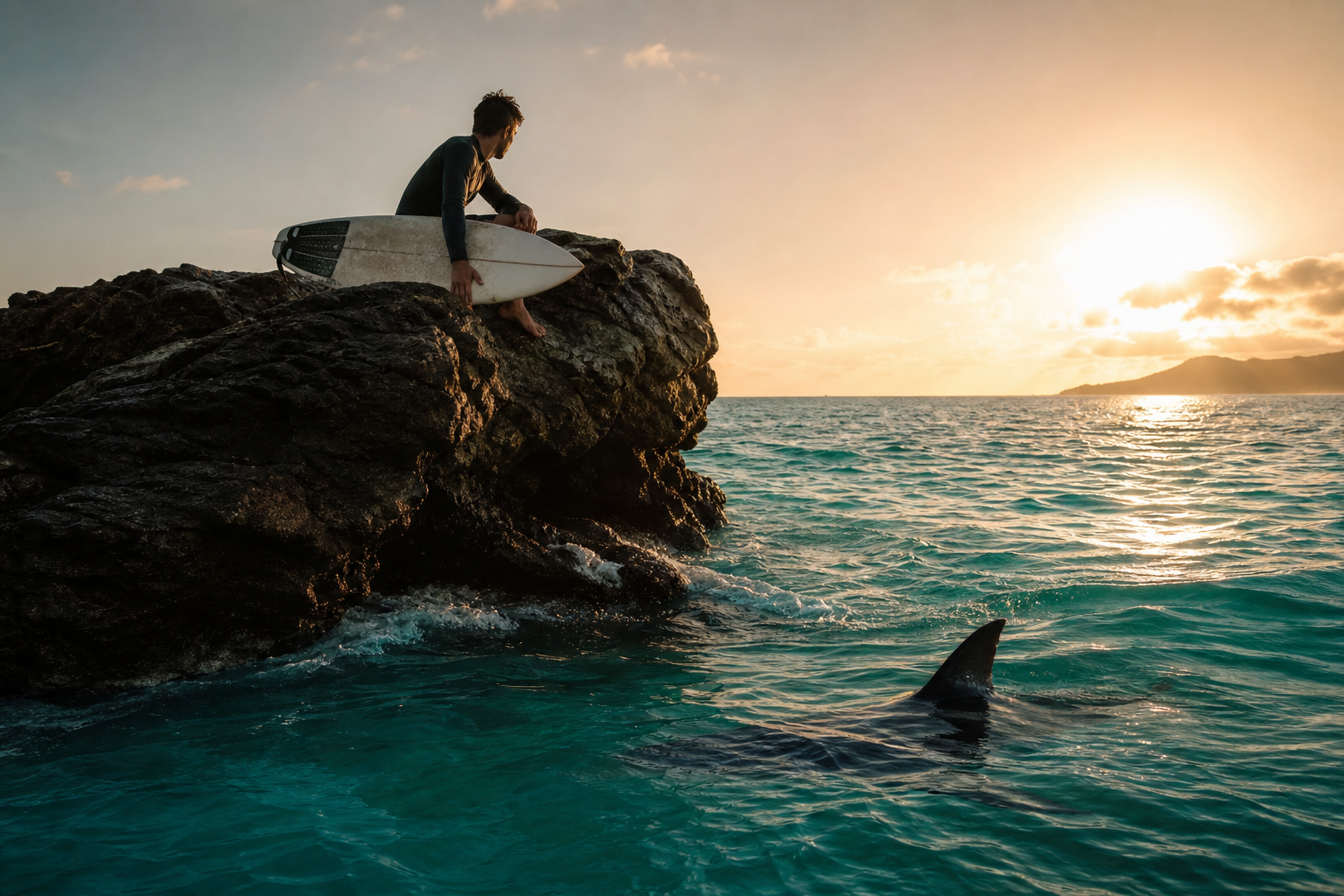
The Shallows is a reminder that a great survival movie can be 86 minutes, one beach, and one excellent premise. Blake Lively plays Nancy, a medical student surfing at a secluded Mexican cove when she is attacked by a great white shark. She makes it to a rock outcrop, but the tide is rising, the shore is close enough to see, and the shark keeps circling. That cruelly simple geography is the movie’s engine.
The details are what sell it: Nancy uses earrings for a field suture, tracks the tide on a helmet camera, shares space with an injured seagull, and keeps recalculating distance as the water rises. Director Jaume Collet-Serra shoots the reef, rock, buoy, and beach like pieces on a board, so you always understand the stakes. The film reportedly cost around $17 million and grossed more than $119 million worldwide, making it one of the smarter small-scale studio thrillers of its decade.
Yes, the shark behavior is heightened for suspense. Real-world shark risk is far lower than the genre suggests, and the Florida Museum International Shark Attack File is the gold-standard public resource for putting attacks in context. As cinema, though, The Shallows understands the pleasure of survival plotting: limited tools, a visible goal, a ticking clock, and a protagonist smart enough to keep you invested.
9The Impossible
Best for: viewers who can handle emotionally devastating disaster realism centered on family survival.
The Impossible recreates the 2004 Indian Ocean tsunami through the experience of one vacationing family in Thailand. Directed by J.A. Bayona and starring Naomi Watts, Ewan McGregor, and a young Tom Holland, the film opens with resort calm before the wave hits with terrifying speed. The sequence is not abstract spectacle; it is impact, debris, drowning, injury, disorientation, and the immediate terror of not knowing who is alive.
The film is based on the real story of María Belón and her family, and it captures the chaos after a mass-casualty disaster: overwhelmed hospitals, missing-person searches, contaminated water, language barriers, and the stunned disbelief of survivors. Watts earned an Academy Award nomination for a performance that is physically brutal and emotionally exposed. Tom Holland’s early performance also stands out because he plays a child forced into adult responsibility almost instantly.
This is not escapist disaster entertainment. The 2004 tsunami killed more than 220,000 people across multiple countries, according to widely cited international estimates, and the movie’s focus on a European tourist family has been debated. Still, as a visceral depiction of nature’s sudden force and the human need to find one another afterward, it is extraordinarily effective. For historical context, BBC coverage of the Indian Ocean tsunami anniversary provides a broader look at the disaster’s scale.
10Society of the Snow
Best for: viewers who want a harrowing true survival story about group endurance, grief, and moral limits.
Society of the Snow is the strongest recent entry in the genre because it understands that survival is not only individual grit. J.A. Bayona dramatizes the 1972 crash of Uruguayan Air Force Flight 571 in the Andes, where members of a rugby team and other passengers endured extreme cold, altitude, avalanches, starvation, and impossible moral decisions for more than two months. The film is immersive, respectful, and devastating.
The specificity is relentless. You see survivors rationing scraps, melting snow, insulating a broken fuselage, dealing with injuries, burying friends, and eventually confronting cannibalism as a matter of survival rather than shock value. Bayona uses Spanish-language performances and a large ensemble to emphasize community instead of turning the story into one-man hero worship. The crash site sat at roughly 11,500 feet in the Andes, where cold, exposure, and isolation made ordinary rescue assumptions useless.
Compared with the 1993 film Alive, this version is more intimate, mournful, and culturally grounded. It is also one of the rare survival films that treats memory as part of the ordeal: who gets named, who gets carried forward, and who tells the story afterward. If you want background on the real event, the history of Uruguayan Air Force Flight 571 gives a clear overview, but the film itself is the more emotionally complete experience.
These movies endure because they make you respect scale. A canyon, a wave, a mountain, a frozen plain, or an animal can erase human confidence in seconds, and the best survival films know that the real drama begins after the first mistake.
If you want the strongest double feature, pair The Revenant with Society of the Snow: one is mythic and individual, the other communal and true-story devastating. Together, they show why nature remains cinema’s most honest antagonist.
Frequently Asked Questions
What counts as a man vs. nature movie?
A man vs. nature movie centers its conflict on humans facing natural forces rather than a conventional villain. That can mean storms, mountains, oceans, animals, deserts, cold, heat, hunger, injury, or isolation.
Why is The Revenant ranked number one?
The Revenant combines survival intensity with elite filmmaking: natural-light cinematography, brutal physical performance, and a wilderness that feels constantly dangerous. It is not the most minimalist film here, but it is the most complete cinematic experience.
Which movie on this list is best for realistic survival tactics?
127 Hours, All Is Lost, and Arctic are the strongest choices for practical survival decision-making. They focus on water, tools, shelter, energy, signaling, and the consequences of small errors.
Which of these movies are based on true stories?
127 Hours, Everest, The Impossible, and Society of the Snow are directly based on real events. The Revenant is inspired by the Hugh Glass legend, though it takes major dramatic liberties.
Are these movies too intense for younger viewers?
Most of them are intense, and several include graphic injury, death, trauma, or frightening peril. Life of Pi is the most accessible option, but parents should still expect shipwreck danger and animal threat.
What is the best short survival thriller here?
The Shallows is the easiest recommendation when you want something fast, stylish, and suspenseful. It has a clean setup, a smart protagonist, and a tight runtime that never drags.
Which movie is the most emotionally devastating?
Society of the Snow is the hardest emotional watch because it spends real time with grief, community, and moral survival. The Impossible is a close second because its disaster sequences and family separation are overwhelming.
What should I watch first if I am new to survival movies?
Start with 127 Hours if you want a lean true story, or The Revenant if you want a large-scale epic. After that, move to All Is Lost for minimalist ocean survival and Society of the Snow for true-story endurance.


