
- 🥇 Best Overall: Time — Inception — the modern blockbuster cue that turns patience into a superpower
- 💰 Best Value: A Real Hero — Drive — a four-minute synth-pop mood-setter that instantly upgrades any playlist
- 🎻 Best Classical Gut-Punch: Adagio for Strings — Platoon — devastating, sacred, and impossible to ignore
- 🌿 Best Comfort Listen: The Shire — The Lord of the Rings — warm, pastoral music that feels like home
- 🌊 Best Romantic Power Ballad: My Heart Will Go On — Titanic — massive vocals, bigger emotion, and true pop-culture permanence
- 🌀 Best Animated Wonder: Merry-Go-Round of Life — Howl’s Moving Castle — elegant waltz magic with instant Studio Ghibli charm
- 🎹 Best Piano Theme: Mia & Sebastian’s Theme — La La Land — bittersweet, playable, and emotionally precise
- 🚀 Best Haunting Minimalism: On the Nature of Daylight — Arrival — slow strings that make time feel fragile
- 🏛️ Best Epic Finale: Now We Are Free — Gladiator — mystical vocals and arena-sized catharsis
- 🌙 Best Classic Standard: Moon River — Breakfast at Tiffany’s — simple, elegant, and permanently cinematic
Beautiful movie music does more than decorate a scene; it tells you what the characters cannot say out loud. The right track can turn a hallway, a spaceship, a battlefield, or a fire escape into a memory you keep for decades.
These 10 tracks and songs are not just famous; they are useful listening, whether you want focus music, a romantic playlist, a crying-in-the-car moment, or a reminder of why cinema still feels magical.
1Time — Hans Zimmer, Inception
Best for: listeners who want a slow-building, motivational track that makes ordinary work feel monumental
Hans Zimmer’s Time is the sound of momentum becoming emotion. Used near the end of Christopher Nolan’s Inception, it starts with a simple piano pattern and gradually stacks strings, brass, and percussion until the cue feels enormous without ever becoming cluttered. That restraint is the differentiator: instead of shouting from the first second, it earns its climax bar by bar.
The track runs about 4 minutes and 35 seconds on the official Inception soundtrack, and it helped define the sound of prestige blockbusters after 2010. Inception grossed more than $839 million worldwide, but Time became bigger than the film in everyday life: you hear its influence in trailers, sports montages, productivity videos, wedding edits, and graduation reels. Zimmer’s writing here is harmonically simple, which is exactly why it travels so well. You do not need the plot mechanics of dreams within dreams to feel the lift.
Use Time when you need a clean emotional arc: studying, writing, running, editing a video, or closing a personal project. The caveat is that it has been copied endlessly, so it can feel familiar even to people who have never seen Inception. If you want the same cinematic patience with a slightly darker edge, compare it with Zimmer’s Cornfield Chase from Interstellar; if you want the most iconic single statement, Time still wins.
2The Shire — Howard Shore, The Lord of the Rings: The Fellowship of the Ring
Best for: anyone who wants comfort, nostalgia, and the feeling of returning to a safe place
The Shire is one of the great musical homes in modern film. Howard Shore’s theme for Hobbiton is gentle, melodic, and grounded in folk colors: whistle, fiddle, soft strings, and a rhythm that suggests walking paths, gardens, bread, ale, and morning light. It stands out because it gives the entire Lord of the Rings trilogy an emotional north star. Before the armies, monsters, and volcanic doom, Shore lets you understand what is worth saving.
The Fellowship of the Ring reached cinemas in 2001 and became a cultural event, with a global box office of about $898 million. The film’s official listing on the Warner Bros. The Fellowship of the Ring page reflects how enduring the movie remains in the studio catalog. Shore’s score won the Academy Award for Best Original Score, and The Shire theme became one of its most recognizable musical signatures, returning in altered forms across the trilogy.
This is the track you play when you want peace without blandness. It is excellent for reading fantasy, making dinner, journaling, or calming down after a long day. The caveat: if you are deeply attached to the films, The Shire may hit harder than expected, because it carries the full weight of Frodo’s journey in miniature. Compared with the grand Fellowship theme, it is smaller, but it is also more intimate and more replayable.
3On the Nature of Daylight — Max Richter, Arrival
Best for: listeners who want haunting strings, slow emotion, and a track that makes time feel physical
Max Richter’s On the Nature of Daylight was not written for Arrival, but Denis Villeneuve’s film made extraordinary use of it. The piece opens and closes the movie with aching string lines that seem to suspend grief, love, memory, and time in the same breath. Its differentiator is patience: it does not chase melody in a traditional pop sense, but it keeps unfolding until you realize you have been pulled into a complete emotional landscape.
Originally released on Richter’s 2004 album The Blue Notebooks, the piece has also appeared in films such as Shutter Island and television projects, but Arrival gave it one of its most powerful placements. You can trace Richter’s broader catalog through Max Richter’s Deutsche Grammophon artist page, which shows how his work sits between classical minimalism, electronic texture, and screen music. In Arrival, the track’s presence was so central that Jóhann Jóhannsson’s original score became a complicated awards case, partly because of the prominent pre-existing music.
Play this when you are ready to sit with a feeling instead of escaping it. It works beautifully for late-night walks, deep reading, quiet reflection, or scenes in your own life that need no words. The caveat is simple: it is heavy. If you want beauty that uplifts quickly, choose The Shire or Merry-Go-Round of Life. If you want beauty that looks you directly in the eye, choose this.
4Adagio for Strings — Samuel Barber, Platoon
Best for: people who want a classical piece with overwhelming cinematic force
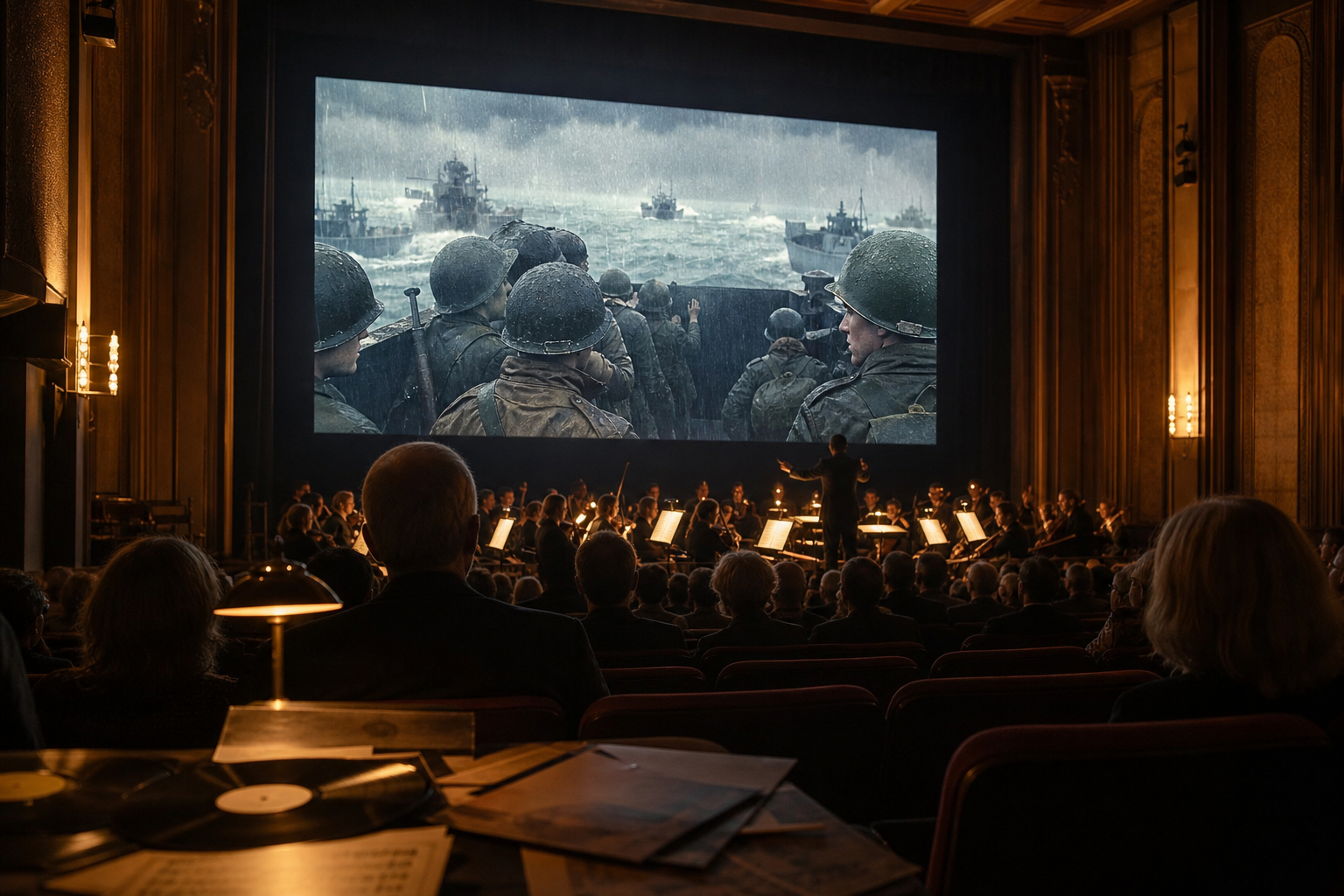
Samuel Barber’s Adagio for Strings is one of the most devastating uses of classical music in film history. Oliver Stone’s Platoon places the piece against images of war, loss, and moral collapse, turning its slow rise and release into a kind of public mourning. What makes it stand out is its purity. There is no need for clever orchestration tricks or modern sound design; the string writing alone carries the grief.
Barber arranged the Adagio from the second movement of his String Quartet, Op. 11, and the orchestral version became a major American concert work long before Platoon. The 1986 film won four Academy Awards, including Best Picture, and the music became inseparable from its most iconic emotional imagery. Depending on the recording, Adagio for Strings usually runs around 7 to 10 minutes, which gives it room to build toward one of the most famous climaxes in 20th-century orchestral music.
Use this track carefully. It is not background music for casual brunch; it demands attention and can overwhelm a room. For a film playlist, place it after something sparse, not after a loud action cue. Compared with On the Nature of Daylight, Barber’s Adagio is more formally classical and more openly tragic. Richter drifts like memory; Barber ascends like a prayer and then breaks your heart.
5My Heart Will Go On — Celine Dion, Titanic
Best for: anyone building a romantic, nostalgic, or full-volume singalong movie playlist
My Heart Will Go On is the rare movie song that escaped the cinema and became a global event of its own. Written by James Horner and Will Jennings and performed by Celine Dion, it turns Titanic’s romance into a power ballad built around the unmistakable tin-whistle-style opening and Dion’s controlled, massive vocal performance. Its differentiator is scale: it is intimate enough to feel like a private memory and big enough to fill an arena.
Titanic became one of the highest-grossing films ever, with more than $2.2 billion worldwide across releases, and the song was central to its afterlife. At the 70th Academy Awards, the film won 11 Oscars, including Best Original Song for My Heart Will Go On, as shown in the Academy’s 1998 ceremony record. The single also dominated radio in 1997 and 1998, becoming one of the defining ballads of the decade.
The tip is to embrace it without irony. Yes, it has been parodied, overplayed, and belted badly at karaoke nights around the world. That does not weaken it; it proves how deeply it landed. For a cleaner listening experience, try the soundtrack version for cinematic sweep or a live Dion performance for vocal firepower. Compared with Moon River, this is not subtle romance. It is romance standing at the bow of the ship with both arms open.
6Merry-Go-Round of Life — Joe Hisaishi, Howl’s Moving Castle
Best for: fans of animated fantasy, elegant waltzes, and music that feels enchanted without becoming sugary
Joe Hisaishi’s Merry-Go-Round of Life is one of the most beloved themes in Studio Ghibli’s catalog. Written for Hayao Miyazaki’s Howl’s Moving Castle, it moves like a waltz seen through a dream: graceful, slightly mysterious, romantic, and full of airborne motion. Its differentiator is balance. It is beautiful enough for a concert hall, but it still feels tied to character, movement, and the strange mechanics of Howl’s magical world.
The 2004 film blends anti-war imagery, fairy-tale transformation, and domestic comedy, and Hisaishi’s music helps keep those tones connected. The official Studio Ghibli Howl’s Moving Castle page places the film within the studio’s own archive of works, where music is never treated as decoration. Merry-Go-Round of Life has since become a favorite for pianists, orchestras, music-box arrangements, and social video clips, partly because the melody remains recognizable even when simplified.
This is a smart choice when you want elegance without emotional heaviness. It works for cooking, drawing, studying, wedding prelude music, or a fantasy reading session. The caveat is that many online versions are unofficial covers, so if you care about the film’s exact orchestral color, choose the original soundtrack recording or Hisaishi’s concert performances. Compared with The Shire, this is less rustic and more ballroom-like; both feel like refuge, but Hisaishi adds a swirl of magic.
7Mia & Sebastian’s Theme — Justin Hurwitz, La La Land
Best for: piano lovers, romantics, and anyone who likes beauty with a little ache in it
Mia & Sebastian’s Theme is the emotional skeleton key of La La Land. Justin Hurwitz writes it with a clean, memorable piano line that can sound hopeful, lonely, flirtatious, or devastating depending on the arrangement. That flexibility is the differentiator. The same musical idea can carry a first encounter, a dream of artistic success, and the sting of an alternate life that never happened.
La La Land was released in 2016 and became a modern musical phenomenon, grossing about $472 million worldwide against a reported production budget around $30 million. Hurwitz won the Academy Award for Best Original Score, while City of Stars won Best Original Song, but Mia & Sebastian’s Theme is the piece many listeners return to when they want the film’s emotional core. It is also practical: intermediate pianists can learn simplified versions, while advanced players can dig into rubato, voicing, and the jazz-inflected phrasing that gives the theme its character.
Play it when you want romance without melodrama. It suits rainy windows, late-night practice, quiet dinners, and those moments when you are thinking about the version of your life that almost happened. The caveat is that it can sound thin if performed too mechanically. This theme needs breath. Compared with My Heart Will Go On, it is smaller and more interior; instead of declaring eternal love, it wonders what love costs.
8A Real Hero — College & Electric Youth, Drive
Best for: night drives, neon playlists, minimalist cool, and people who like their movie music stylish but emotional
A Real Hero, by College and Electric Youth, is one of the great modern examples of a pre-existing song becoming fused to a film’s identity. In Nicolas Winding Refn’s Drive, it captures the Driver’s fantasy of nobility: calm surface, hidden danger, and a private code that may or may not save anyone. The differentiator is its restraint. The song is soft, steady, and synthetic, but it carries a surprising emotional charge.
The track was released before Drive, but the 2011 film gave it a lasting cinematic context. Its clean synth pulse, gentle vocal delivery, and repeated heroic imagery fit the movie’s Los Angeles nights, satin jacket, and sudden violence. Drive was made for a reported budget around $15 million and became a cult favorite rather than a giant blockbuster, which actually helped the song. It feels discovered, not manufactured.
This is the best value pick because one track gives you an entire atmosphere in minutes. Add it to a late-night playlist and it immediately sets a temperature: cool, reflective, slightly dangerous, and romantic from a distance. The caveat is that its subtlety can disappear on bad speakers, so headphones or a car system with decent low-end help. Compared with Time, it is less monumental; compared with Mia & Sebastian’s Theme, it is less vulnerable. Its beauty is in the glow.
9Now We Are Free — Hans Zimmer and Lisa Gerrard, Gladiator
Best for: listeners who want an epic closing track with spiritual lift and cinematic release
Now We Are Free is the emotional exhale at the end of Gladiator. Composed by Hans Zimmer and Lisa Gerrard, it blends orchestral writing with Gerrard’s unmistakable vocals, which use an invented, intuitive language rather than conventional lyrics. That choice is the differentiator. Because the words are not tied to one literal meaning, the track can feel ancient, personal, sacred, and universal at the same time.
Ridley Scott’s Gladiator arrived in 2000, grossed more than $460 million worldwide, and won five Academy Awards, including Best Picture and Best Actor for Russell Crowe. The score was also Oscar-nominated and became one of the most influential epic soundtracks of the early 2000s. Now We Are Free appears in several versions and edits, but the core appeal remains the same: warm harmony, spacious rhythm, and a vocal line that seems to rise above the brutality of the arena.
Use this track when you want closure. It is excellent after a workout, at the end of a long travel day, or as the final piece in a cinematic playlist. The caveat is that it is so strongly associated with Gladiator that it can pull you directly back to Maximus and the wheat field imagery. If that is what you want, nothing else substitutes. Compared with Adagio for Strings, it is less tragic and more releasing, grief transformed into peace.
10Moon River — Audrey Hepburn and Henry Mancini, Breakfast at Tiffany’s
Best for: classic-film fans, romantic minimalists, and anyone who believes a simple melody can outlast spectacle
Moon River is proof that a movie song does not need to be huge to be immortal. Composed by Henry Mancini with lyrics by Johnny Mercer, it is performed in Breakfast at Tiffany’s by Audrey Hepburn in a famously intimate fire-escape scene. The differentiator is simplicity: a modest vocal range, a gently flowing melody, and a mood that feels both hopeful and lonely.
The song won the Academy Award for Best Original Song for 1961 and became a standard recorded by artists including Andy Williams, Frank Sinatra, Louis Armstrong, and countless jazz and pop performers. In the film, Hepburn’s version is not technically flashy, which is the point. It sounds like a private thought accidentally overheard. The song’s cultural endurance is also the kind of American popular music preservation that institutions like the Library of Congress National Recording Registry exist to recognize and protect.
Play Moon River when you want elegance, not excess. It is ideal for Sunday mornings, dinner playlists, classic cocktail hours, or the last song before the lights go down. The caveat is that some versions become too polished and lose the fragile charm of the film performance. If My Heart Will Go On is a grand romantic monument, Moon River is a handwritten note kept in a drawer.
Great movie music survives because it keeps working after the credits end. Whether you choose Zimmer’s slow-burn architecture, Hisaishi’s animated grace, Richter’s aching strings, or Mancini’s classic simplicity, each track gives you a direct route back to a feeling.
Build your playlist around contrast: one epic cue, one intimate piano theme, one classic song, one synth track, and one piece that lets you sit quietly for a while. That is how a soundtrack list becomes something you actually return to.
Frequently Asked Questions
What makes a movie soundtrack track beautiful?
Beauty usually comes from a clear emotional purpose, not just pretty melody. The best film tracks support the scene, reveal character, and still stand on their own when you hear them away from the movie.
Are these tracks better on vinyl, CD, or streaming?
Streaming is the easiest way to compare versions quickly, and most tracks here sound excellent on major platforms. Vinyl can be rewarding for albums like La La Land, Drive, or Gladiator if you enjoy artwork, sequencing, and warmer playback, but it usually costs more.
Which track is best for studying or focused work?
Time, The Shire, and Merry-Go-Round of Life are the safest picks because they create momentum without demanding constant attention. Avoid My Heart Will Go On or Moon River for deep focus if lyrics distract you.
Which of these songs is best for a wedding playlist?
Moon River is the most elegant classic choice, especially for a ceremony prelude or first-dance alternative. For bigger drama, My Heart Will Go On works, but you need a crowd that will embrace its full emotional scale.
Why are some famous film tracks not originally written for the movie?
Directors often use pre-existing music because it brings a specific emotional history or texture that an original cue might not replicate. On the Nature of Daylight in Arrival and A Real Hero in Drive are strong examples of older tracks becoming newly iconic through placement.
What is the best entry point for someone new to film scores?
Start with Time, The Shire, and Mia & Sebastian’s Theme because they are melodic, accessible, and easy to connect with immediately. Then move into Adagio for Strings and On the Nature of Daylight when you want heavier emotional weight.
Can I use these tracks in my own videos?
Not without proper licensing. These are copyrighted recordings and compositions, so personal listening is fine, but public use on YouTube, ads, podcasts, or social campaigns usually requires permission or a licensed music source.


